Categories

Showing posts with label stories. Show all posts

Saturday, June 16, 2012

Training the Child

Everyone has an opinion about how to raise a child.  I am not braver enough to offer my own however I will defer to an opinion piece from 1936

THESE are times when one hears much concerning the bringing up of children. I was glad to notice that Professor Lovell, speaking in Sydney, referred to some of the theories that, are current regarding the training of boys and girls in which any kind of repression is considered wrong. Professor Lovell offered a few words of sane thought to parents that are worth their study. America is, I believe, the centre from which came the view that a child should be allowed to manifest every emotion and desire with little, if any, check. This always seems as absurd as tho opposite view prominent in Britain in the mid Victorian era, and also in Puritan times, which sternly repressed every tendency and desire. Going back to Sir Walter Scott's day he tells how, when a little boy, he said during dinner: . "How good this soup is," on which his father ordered a pint of cold water to be poured into it as a lesson not to think of his appetite. But one extreme is as foolish as another, and while one condemns Sir Walter Scott's father as a stupid per- son, we must also condemn those who believe that the child does not need checks. There is a difference between, guidance and training even to the extent of forbidding certain things, and that rather dangerous plan of permitting children to follow their wishes without hindrance. Just as an engine needs a governor to control its power, so does the human engine require a governor, and this is supplied by that rational training that breeds discipline within, and imposes its own restraints by the use of reason and judgment.

Source


1936 'DAY BY DAY.', The Mercury (Hobart, Tas. : 1860 - 1954), 12 May, p. 6, viewed 16 June, 2012, http://nla.gov.au/nla.news-article25217232


Wednesday, May 9, 2012

1500 Miles in a Lifeboat: 27 Days on the Open Sea

I used a a random number generator and chose the year 1902 for todays story.  It is a nautical adventure something that Joseph Conrad could have have written. This is the actual article as it appeared in the Sydney Morning Herald, May 9th 1902. This ship was a frequent visitor to Sydney Harbour over the years.


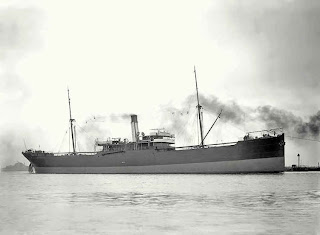
S.S Boveric 1906

The anxiety which was felt regarding the overdue steamer Boveric was relieved to an extent today by the receipt of a telegram from Fremantle announcing, as was generally surmised, that the vessel had met with no more serious misadventure than the loss of her propellor. This, under the circumstances, welcome news was brought by the chief officer of the Boveric, Mr Hayman, who together with three of the crew of the Boveric had sailed 1500 miles in an open lifeboat to seek assistance for the disabled vessel.

The heroic adventurers were picked up off the coast near Fremantle on Wednesday afternoon by the steamer Willyama, and brought on by that vessel to the Western Australian port they had had a long and arduous experience, having been no less than 27 days in the life before they were discovered,  and their cruise has probably established a record as regards distance and time in lifeboats

At the time of her mishap the Boveric was approximately 500 miles north of the regular track of steamers coming from South Africa, and the chances of her being discovered by vessels coming from the Cape were remote. When going from Australia to South   Afica steamers especially those with live stock on board-proceed over a much higher latitude than that taken by vessels coming the reverse way. The object of this is to escape, as far as possible, the strong westerly winds which sweep the lower latitudes of the Southern Ocean. More favourable conditions are found over the higher latitudes, and it was for this reason that the Boveric, with her valuable freight of 960 horses on board, was ordered to steer a course between the parallels of 28° and 32°. Upon the receipt of the news of the accident the Howard Smith Company entered into negotiations for the despatch of one or two steamers from Western Australia to search for the disabled vessel. The company has not at present a steamer in the west which would be suitable for such a mission, and they are therefore arranging for assistance outside their own fleet. The negotiations which are in progress were not concluded up to tonight but it is almost certain that aid will be sent to the helpless steamer to morrow.

The voyage of the Boveric began inauspiciously for Mr Hayman, the chief officer, and there seemed a prospect at one time that he would not be able to   go away in her. Whilst the last batch of horses was being shipped at Port Melbourne the day before the departure of the vessel one of the animals made a savage attack with its teeth on Mr Hayman, inflicting an ugly wound on one of his shoulders. The injured officer suffered acutely from the effects of the bite but resolutely stuck to his post. Mr Hayman is well known in connection with coastal shipping Before joining the Howard Smith line he was in the service of the   Adelaide S.S. Company, Limited. Although it is  understood that the Boveric is amply provided with provisions for the crew, there is grave doubt as to how the horses will fare in event of the voyage being much further prolonged. When the Boveric left here she took sufficient fodder to last the animals for 45 days, but it is more than likely that when the accident occurred their daily allowance of fodder was reduced in order to provide as far as possible for a protracted sojourn at sea. The vessel has now been 48 days out from this port the opinion is expressed by several nautical men that a vessel following the course of the prevailing current from the spot where the Boveric began to drift would probably be swept across to the coast of Mauritius.

The manager for Howard Smith and Co. received a telegram tins afternoon from the chief officer of the Boveric at Fremantle as follows : -"Boveric lost her propeller April 3, latitude 30°42 south longitude 93 42 east drifting till 11th, when chief officer left, about 25 miles per day north-west directions Should be well northward of Australian-South African track " .

For those who like a happy ending

The Boveric arrived at Freemantle in tow of the steamer Narrunm, which turned back from her journey to South Africa to render this service. The passengers and crew of the Boveric, and the horses on board, are well and in splendid condition.


Sources

1902 'THE S.S. BOVERIC.', The Sydney Morning Herald (NSW : 1842 - 1954), 9 May, p. 7, viewed 8 May, 2012, http://nla.gov.au/nla.news-article14440755


1902 'THE BOVERIC.', The Horsham Times (Vic. : 1882 - 1954), 16 May, p. 3, viewed 8 May, 2012, http://nla.gov.au/nla.news-article72847971

Monday, May 7, 2012

Constable attacked 7th of May 1930

On the 7th of May 1930 (82 years ago to the day) a very brave NSW police officer, Constable Clinch was attempting to arrest two young men who had allegedly been assaulting a Taxi driver. One of the men resisted arrest however he was able to arrest the other.


A Taxi driver was attacked at the corner of George St and Quay Streets early in the morning by two men that tried to rob him. The Taxi driver refused to hand over the money whereupon both men attacked him. Constable Clinch heard the commotion and went to assist the driver, unfortunately both men turned on him. During the ensuing scuffle the Constable was thrown several times. One of the men was able to grab the Constable's baton form his hip pocket and struck him on the head inflicting a gash to his forehead. Despite this and the fact blood was flowing down his face Constable Clinch hung onto the one of the men until he was able to handcuff him. 


The arrested man was apparently a professional boxer and was charged with demanding money with menace and assaulting the Taxi driver, assault police and carrying an unlicensed pistol (He was lucky he wasn't shot).  It is not often today that police work 'one' out.  Many of the situations that they would have had to deal with as a single unit. Constable Clinch ended up being taken to the Royal Prince Alfred Hospital suffering from concussion.  From what I have researched he ended up working in Rose Bay.  There is a story about him assisting a woman attempting suicide at the 'Gap' in the early 40's
.
View Sydney a History in a larger map
Source
1930 'CONSTABLE ATTACKED.', The Sydney Morning Herald(NSW : 1842 - 1954), 7 May, p. 14, viewed 7 May, 2012, http://nla.gov.au/nla.news-article16700598 

Sunday, May 6, 2012

Mystery of the Falling Frogs

We have had a lot rain lately but in all that wet I didn't see any frogs.  However on Tuesday the 2 December 1947 a shower of rain in Newtown apparently brought out hundreds of frogs.  Some of the eyewitnesses claim that the frogs came down with the rain.  This reminds me of the final scene of "Magnolia" in which Los Angeles experiences frogs raining from the sky. Apparently the technical term is a 'raining animal' event.  A teenage boy from Newtown said that he saw frogs hitting the ground in front of him on King Street (Princess Highway) and Yelverton Street.  There were hundreds of small ones and a few big ones he claimed.  Most of them were green and few were brown. Those that did not suffer fatal injuries from reaching terminal velocity were squashed by cars.
Thankfully after consulting Wikipedia my doubt about this 'natural' phenomena was all but cleared up.  One of the theories is that strong winds traveling over water sometimes pick up creatures such as fish or frogs and carry them for several miles.  The scientists in 1947 suggested it might have been a waterspout.  However they also pointed out that frogs which would die in dry conditions hide in cracks and under cover and come out in great numbers with rain.   

View Sydney a History in a larger map

Sources

 1947 'MYSTERY FROGS.', The Sydney Morning Herald (NSW : 1842 - 1954), 3 December, p. 3, viewed 6 May, 2012, http://nla.gov.au/nla.news-article18052015

Wikipedia contributors. Raining animals. Wikipedia, The Free Encyclopedia. April 29, 2012, 14:33 UTC. Available at:http://en.wikipedia.org/w/index.php?title=Raining_animals&oldid=489789630. Accessed May 6, 2012.

Friday, May 4, 2012

Wreck of the Dunbar

The other day I took a walk in Camperdown Cemetery in which the many of the remains of the victims of the Dunbar were buried. It is an interesting story and most visitors to the "Gap" are familiar with it as the salvaged Dunbar anchor is a reminder of the tragedy

The Dunbar

On August 20th,1857, Sydney experienced one of the stormiest nights recorded. In the height of that howling storm the " Dunbar," Captain Green from London, with a large number of passengers, was driven on to the South Head and with the exception of a seaman, James Johnston, all crew and passengers were lost. Johnston the sole survivor was washed on to a ledge of rock at the base of Jacob's ladder at the Gap. His rescue from his perilous position two days later by a brave young Icelander, Antony Wollier, is a thrilling story.

The Rescue: Antony Wollier, having been at Jacob's Ladder saw a man lying on a shelf of one of the rocks. He warned the rescuers above. A spar, a thick strong pole was run out over the cliff where Johnston was stranded. Double blocks, tackle and falls were rigged by many of the rescuers who most likely had nautical rigging experience. Wollier volunteered and risked his life to be lowered down where Johnston lay. Wollier found him and gear was sent down Johnston fixed himself securely and was safely hauled up in an exhausted state.


A coincidence in connection with Johnston, the sole survivor of the " Dunbar," is that the, nine years after his providential escape, when Light House Keeper at Newcastle, rescued the sole survivor of the " Cawarra," lost at Nobby's in 1866. Sydney has had many wrecks at the Heads, and our coasts unfortunately bear a long toll of shipping disasters, but no wreck in our history is so widely remembered as that of the "Dunbar


The Funeral: These remains were collected and accorded a public funeral on Monday, August 24th to St. Stephen's Cemetery, Camperdown. Business places along the route were closed and profund sorrow was manifested by the people. When the long funeral procession reached the churchyard darkness had set in, and the service had to be conducted by the light of improvised torches. The Government erected a monument over the remains of the " Dunbar " victims and those lost a few months later, 24th October, 1857, in the wreck of the "Catherine Adamson," at North Head. This monument is one of the features of the old churchyard and attracts many visitors to St. Stephen's.

Sources:

1887 'WRECK OF THE DUNBAR.—THE RESCUER.', The Sydney Morning Herald (NSW : 1842 - 1954), 25 August, p. 3, viewed 4 May, 2012, http://nla.gov.au/nla.news-article13662087

 1923 'The Great Wreck.', Queanbeyan Age and Queanbeyan Observer (NSW : 1915 - 1927), 28 August, p. 2, viewed 4 May, 2012, http://nla.gov.au/nla.news-article31680866

Wednesday, May 2, 2012

Out of Control Ferry


Imagine that you sitting on the ferry and the Captain is not at the wheel. This is what happened on Tuesday, 16 November 1926, according to the Singleton Argus. Two young men prevented a disaster on the harbour on this day. The Sydney ferry steamer the Kosciusko with nobody at the wheel, was heading for Manly. Two young men from Neutral Bay, were sitting in the front of the wheelhouse wondering why the ferry was not changing her course and why the siren did not sound. 


Ferry Kosciusko, Sydney Harbour, ca. 1930


They went to investigate and looked in the wheelhouse and they were amazed to find that it was empty. Both boys rushed to grab the wheel, they telegraphed the engine room for “full speed astern" and they swerved the ferry from her course. They completed this manoeuvre just in time, for passengers say that the ferry the Baragool missed the Kosciusko by no more than a foot, running parallel along her side.

When the ferry left the wharf it went straight ahead, for the safety pin was in the wheel and the rudder was locked.  It had not gone far when the Baragoola, heading for its berth appeared.  The Captain of the Baragoola sounded its siren but there was no reply from the Kosciousko.  Fortunately one of the young men, Russell Gillies knew something about the steering mechanism and he released the pin, swerving the Kosciousko just clear of the Baragoola, the master of which slowed down when the Kosciousko did not stop as expected.

Reports to the NSW State Navigation department concluded that the Captain had become ill and went onto the wharf, forgetting to inform the wharfinger that he would be temporarily absent from the wheel.  In his absence the engineers were changed they started the engine not knowing that the Captain was not at the wheel (Sounds like the Labour Party).

Sunday, December 11, 2011

Murder of a Boxer- 9th of October 1935

Tickner Shot

Leslie Gordon Tickner was a boxer and a sheet metal worker and was only 22 years old when he was murdered on the night of Wednesday the 9th of October 1935.  He was shot to the head from behind and killed instantly in the Kitchen of his home, a semi-detached cottage on the Princess Highway, St Peter's.

Typical Police call box, Kings Cross from the 1930's.
This may have been similar to what Stack may have used. (City of Sydney Archives,SRC10551. Originally part of CRS 44/256)
Leslie's body was discovered by his house mate John Stack.  Leslie had been sitting on a kitchen chair when the fatal shot was fired from behind him.  The bullet passed through his head and embedded itself in the door of the wardrobe.  Leslie was found doubled up with his hands bent under him.  Death would most likely have occurred instantly.

When Stack found his friends body he ran into the street and telephoned the police from the nearest call box.  Detective Inspector Smith from Newtown Police was in charge of the case.  At the crime scene police located several empty beer bottles and a number of glasses with dregs.  Suggesting that Leslie had been drinking with a number of other people.  Dr Palmer, the Government Medical Officer inspected Leslie's body and asserted that he had been dead for about four or five hours.  Allowing police to make an initial determination of the time of death about 9pm.

Police speculated that Leslie was killed by someone he knew or regarded as a friend. The investigation started in earnest  and by the Friday police had interviewed over fifty witnesses.  Initially the focus of the investigation attempted to establish Leslie's movements on the fatal evening. A short piece in the Canberra Times revealed that there were at least two men in the house after the fatal shot had been fired.

Arrest of Blanche Peterson

Less than a week after the murder police had arrested and charged his 18 year old girlfriend, Blanche Peterson.  Stack said that he had been to the races during the day and had seen Leslie about 7.30pm when he arrived home.  Stack then had dinner with a next door neighbour Hilder returning home about 12.15am to find Leslie dead.

It appears that Leslie was a young man with acquaintances